
ESL Resources
Word Frequency in Google Books
27/06/2014 11:40
In my last article, I showed you how to determine the frequency of words. Using all the words that Google searches, we were able to compare the frequencies of different words. We found that “good” was more common than “lost” and “angry” was more frequent than “fortunate”
In any language, our vocabulary changes from one situation to another. When you write a formal letter for your company, you will use specific formal words. In contrast, when you talk to your girlfriend on the phone, your language will be very different. More generally, this is true about spoken and written language. Furthermore, language used in books is usually more formal and standardized than the written language used on the internet. Nevertheless, there are still many similarities.
The previous article showed you how to find the frequency of vocabulary on the internet. In this article, I will show you how to find the frequency of words in books using Google Books. This idea came from this Ted Talk.
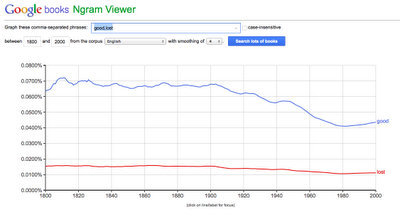
Thanks to Google Labs, we can see how frequent words are in about five million books. Do you remember what we discovered about “good” and “lost”? The frequencies were 1,600,000,000 and 408,000,000 respectively. Look at the chart from Google Ngram Viewer and compare the results. View the full image here.
Now remember the frequency chart we made:

You can compare it to the results from Google Books. View the full image here.
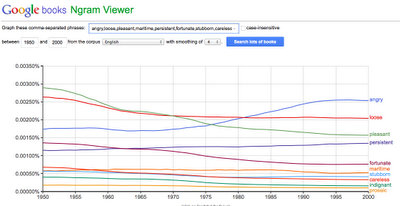
As you can see, the results are quite similar, but there are some differences. Google Books measures the frequency by percentage and google.com counts the number of hits, but, for us, the meaning is the same. WIth this site from Google Books, we can find out what words are more common. Then we can learn those more common words to enable us to communicate better!
Learning new vocabulary -- What words are useful?
31/05/2014 15:15Learning vocabulary is important. The Oxford English Dictionary contains about 250,000 words on 21,728 pages. A native speaker of English might know 35,000 to 75,000 words. Students in China taking the gaokao before university should know 3500 words in English.
Do you want to understand English articles? You need to know more than 3500 words, but it is impossible to learn 250,000 words. So which words do you learn? You should learn words that people use frequently. You should learn words that you will see often. Here is the problem: how do you know which words are common? When you read an article in English, there will be many words you do not know. Which ones should you learn?
Now I will suggest one method. There are other methods, but I think this one is useful. Search for a word on the internet using google.com or bing.com and you will get something like this:
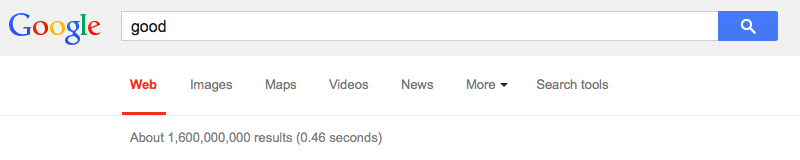
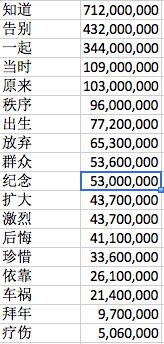
Do you see the number 1,600,000,000, namely one billion six hundred million? This shows that the word "good" is common. Less common words will produce smaller numbers. Try searching some words and see what you get. Generally, a more common word will produce a bigger number. Look at the list that I made:
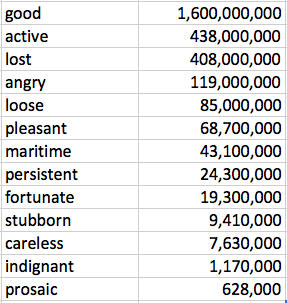
A smaller number means the word is less common. If you are a beginner, you need to learn very common words. If you are an advanced learner, you will learn less common words. Even at the advanced level, you should be learning the most frequent words which you don't know.
If you search for the word "good" next week, the number will be a little different. I am writing this article in May 2014. So if you read this in 2015, these numbers will not be accurate. This means you need to make your own list. The common words you learn will be useful whenever you use English. Don't give up.
I, Douglas, am learning Chinese and I am using this method. If you know Chinese, look at the list below. What do you think?
Are movies and TV too difficult? Try watching children's programs.
23/05/2014 14:04What do you think about English TV and movies? You probably think the English is too difficult to understand. If you think these programs are too difficult for you, I have a suggestion. You should watch some shows made for children.
Some children's programs are too difficult, but other programs use slow and simple English and repeat a lot. I will suggest some programs with easier English. If you don't like these, you can search for ones you like. Here is a short list:
Sesame Street
Kermit and Elmo Discuss Happy and Sad
Mr Rogers Neighborhood
You can find some more videos by Mr. Rogers here.
Arthur
Is there a doctor in the house?
The Chronicles of Narnia: The Silver Chair
English/English Dictionaries -- Should I use one? Which one?
30/01/2014 12:15I have been teaching English as a second language to students for years. Often when I look at their dictionaries, I find that the definitions in their English/Chinese, English/Spanish or English/other language dictionary is not very accurate. In other words, the English in those dictionaries is not very good. So you should start using an English/English dictionary as soon as you can.
So the next question is: which dictionary is best. You can find dictionaries on websites, buy a book in a bookstore or get an app for your phone. I will discuss some websites and one app.
First, I will introduce a website which I believe is not helpful. Then I will show two websites which are helpful. In this comparison, I will show you the same word, "sustainable", in all three dictionaries. It is academic word of B1 difficulty.
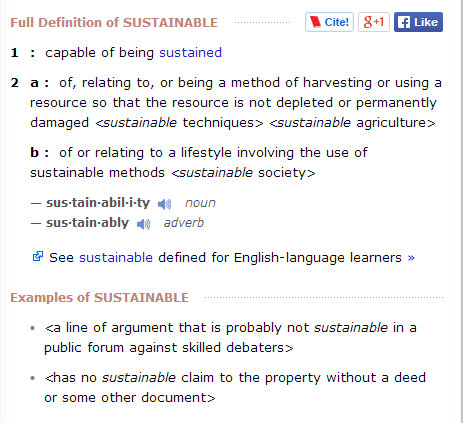
This definition comes from https://www.merriam-webster.com/ As you can see, definition 1 does not help us understand the word. Definition 2 is too difficult to understand. This is the wrong kind of dictionary for you to use.
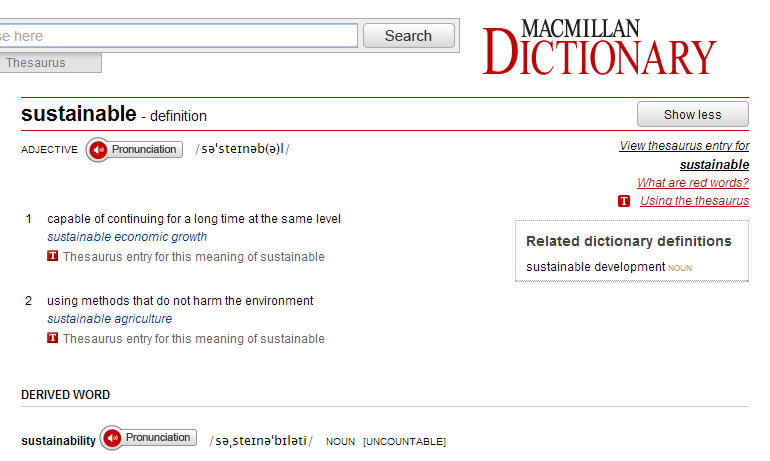
Now I will show you two other dictionaries that are wonderful for English learners. The MacMillan Dictionary can be found at https://www.macmillandictionary.com/. It has the same two meanings as the Merriam Webster dictionary, but the English is much easier to understand. You can also listen to the pronunciation and look at an example sentence or phrase.
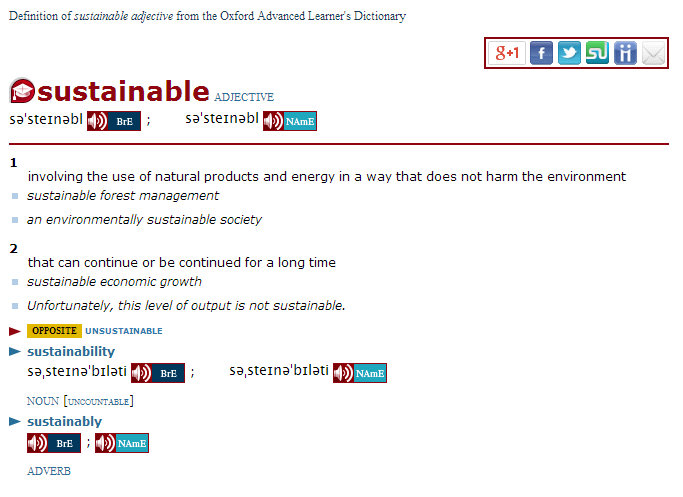
Now the last dictionary is the Oxford Advanced Learner's Dictionary(OALD). I recommend that you look at both MacMillan and OALD when you are learning new vocabulary. The OALD has the same two meanings as the other two dictionaries. The definitions are different from MacMillan, but they are not too difficult to understand for the intermediate to advanced learner. Another great part of this dictionary is the pronunciation. It has BrE (British English) and NAmE (North American English).
One last thing I should mention: the OALD also has an app for Android and iPhone. Watch this video to see the app. If you buy the app, you can use this dictionary when you are not conncted to the internet. It is expensive, but it is an excellent resource.
TuneIn -- Practice Listening on Your Phone
14/01/2014 16:47If you want to be good at listening, you need to listen to many hours of English. In other words, you need to listen a lot. You should always have access to English audio on your phone. You can listen on the bus. You can listen while you are waiting for a friend. You can listen at any time, and you should be listening more.
There are many sources of good English audio. TuneIn is one of the most convenient. Use it on your Adroid or iPhone device. You can try the free version. I recommend that you pay for the premium version so that you can record what you hear.
For great listening practice, browse talk radio. You can listen to people talk about business, film, science and even video games. Simply choose what interests you. There are many categories.
With the premium version, you can make recordings. When you find a good program, record it. Later you can listen to it again. You can also do a dictation of the program or do other listening exercises with the program.
TuneIn is definitely a valuable tool to improve your listening ability.
Improve your writing with Lang-8
26/12/2013 19:12How can you improve your writing? If you write more, you might not improve your English. You need native-English speakers to help you correct and improve your writing. This is great but maybe your teacher or English-speaking friend is too busy. Here is your problem.
The solution is Lang-8. It is a community of people who are learning other languages. Maybe you need to improve your English writing, but you can help someone else improve their Chinese writing. It is a community where people help each other. If you help someone with their writing, someone will help you with your writing.
This is a great way to get feedback about your writing. You can post something every day or every week. You can write a few sentences or a long story. Start writing! Visit lang-8.com to begin.
Watch this video to find out more.
Youtube Interviews
05/12/2013 21:07
There are thousands of possibilities. Simply choose someone who interests you and begin listening.
ESL News
01/12/2013 21:03Where can I find easier news to practice reading and listening?
One good place to start is Voice of America Learning English (VOA). There are a lot of interesting stories to read or listen to. They say that their stories are "written using vocabulary at the intermediate and upper-beginner level and are read one-third slower than regular VOA English."
I think the website is useful for higher level students as well.
Another great site is BBC Learning English. This site uses British English, unlike VOA, but both sites have excellent resources.